Claude terminology, simplified
A collection of terms and explainers covering important Claude terms.
 By Mahmoud Al Juaidi
What is Anthropic?
Anthropic is an AI safety company that develops Claude and offers it through its own apps, an API for developers, and partner platforms.
Knowing the company behind Claude helps you judge its direction, policies, and product choices.
What is a Prompt?
A prompt is the input you give Claude, such as a question, instruction, pasted text, or uploaded file, that shapes its response.
Clear, specific prompts with context usually produce more useful answers.
What is a Context window?
The context window is the amount of text Claude can consider at one time, including your messages, its replies, and any files in the conversation.
Long projects may need summaries or fresh conversations to keep Claude focused.
What is AI Hallucination?
A hallucination is when an AI produces confident-sounding information that is false or unsupported, such as invented facts, fake citations, or incorrect code.
Verify facts, sources, and code before relying on them, especially for high-stakes work.
What is an Agent?
An agent is an AI system that carries out multi-step tasks with some independence, such as working with files or using tools, rather than only replying in chat.
Agents save time on routine work, but their actions should be reviewed, especially when they change files or send messages.
What is a Claude Artifact?
An artifact is a self-contained piece of output, such as a document, web page, app, or piece of code, that Claude displays separately from the chat so you can view, edit, or reuse it.
Artifacts make larger outputs easier to work with and iterate on.
What is an AI Model?
A model is the trained AI system that generates Claude's responses. Anthropic offers models with different balances of speed, capability, and cost.
Picking the right model affects both the quality of results and usage costs.
What is an API?
An API (application programming interface) lets developers connect Claude to their own software, apps, and services.
The API lets Claude be built into products and systems beyond the chat interface.
What is a Connector?
A connector is a link that lets Claude access external services, such as email, calendars, or files, with your permission.
Connectors let Claude work with your real information, so review what it does with that access.
What is a Token?
A token is a small unit of text that Claude processes, roughly a word or part of a word.
Usage limits, API pricing, and how much fits in a conversation are often measured in tokens.
What is Claude?
Claude is an AI assistant made by Anthropic. It can understand and write text, analyze documents and images, write and debug code, and help with research, writing, and everyday questions.
Key points
- Conversational: You interact with it in natural language through chat or through apps and tools.
- Broad: It handles a wide range of tasks, from drafting emails to explaining technical concepts.
- Limited: It can make mistakes and has no access to live information unless it's given a search tool.
Claude AI speeds up work, but it can make mistakes and so its output should be checked, especially for facts, code, and high-stakes decisions.
What is Claude Cowork?
Claude Cowork is an agentic desktop app from Anthropic for knowledge work, built for people who don't write code. It carries out multi-step tasks on your computer, such as working with files and documents.
Key points
- Agentic: It completes multi-step tasks rather than only replying in a conversation.
- Connected: It can use Claude in Chrome, Claude in Excel, and Claude in PowerPoint as tools.
- Remote: You can reach it from the Claude mobile app.
Advantage
It lets knowledge workers hand off routine, multi-step tasks, though you should review its output before relying on it.
What is Claude Design?
Claude Design is a visual design tool from Anthropic that turns text descriptions into prototypes, slide decks, one-pagers, and other visual assets. It is aimed at people without design backgrounds and is in research preview for Pro, Max, Team, and Enterprise subscribers.
Key points
- Brand-aware: It reads a team's codebase and design files to build a design system of colors, typography, and components.
- Complementary: Anthropic positions it to work alongside tools like Canva rather than replace them.
- Exports and handoff: Work can be exported as PDF or PPTX, shared as a URL, or moved to Canva or Claude Code.
Why it matters
It lowers the barrier to early-stage visuals, though it's aimed at ideation rather than final production design.
What are Skills?
A skill (or /skill) is a folder of instructions and best practices that Claude reads before completing a specific type of task.
Key points
- Examples: Creating Word, PDF, or PowerPoint files, or following a particular writing or design approach.
- Sources: Skills can come from Anthropic, be built by users, or be shared within a team.
Why it matters
Skills give Claude proven methods for a task, which usually improves the quality and consistency of the output.
What are Plugins?
A plugin is a package that bundles related skills, connectors, and settings into one installable unit.
Key points
- Contents: Typically a set of skills plus the tools or connections they need for a workflow.
- Customization: Plugins can be tailored to an organization's tools and processes.
Why it matters
Plugins make it easier to set Claude up for a specific job without configuring each piece separately.
What are Scheduled tasks?
A scheduled task is work that Claude runs automatically on a set cadence, or on demand, without you starting it each time.
Key points
- Cadence: Hourly, daily, weekly, or weekdays.
- Capabilities: Scheduled tasks can use the same connectors, skills, and plugins as regular Cowork tasks.
- Cloud runs: In Cowork, they run on schedule even when your computer is asleep or the app is closed.
- Within a project: Tasks created in a Cowork project belong to that project and use its instructions and memory. Local project folders may not be reachable from cloud runs, so check this in your setup.
Recurring work gets done without you, but review the results, especially for anything that acts on your behalf.
What are Claude Projects?
A project is a workspace in Claude where you group related chats, files, and instructions around one ongoing goal.
Key points
- Contents: Project files, custom instructions, and the chats that belong to it.
- Continuity: Claude can draw on the project's files and instructions in each new chat within it, so you don't have to re-explain the background.
- Memory: Each project keeps its own memory. An account-memory setting controls whether that memory is shared with chats outside projects.
Why it matters
Projects keep long-running work organized and reduce repetition, though memory and file access depend on each project's settings.
One useful Claude idea at a time
Practical Claude ideas for your work, the UAE AI stories worth your time, and first notice of trainings.
Keep reading
All articles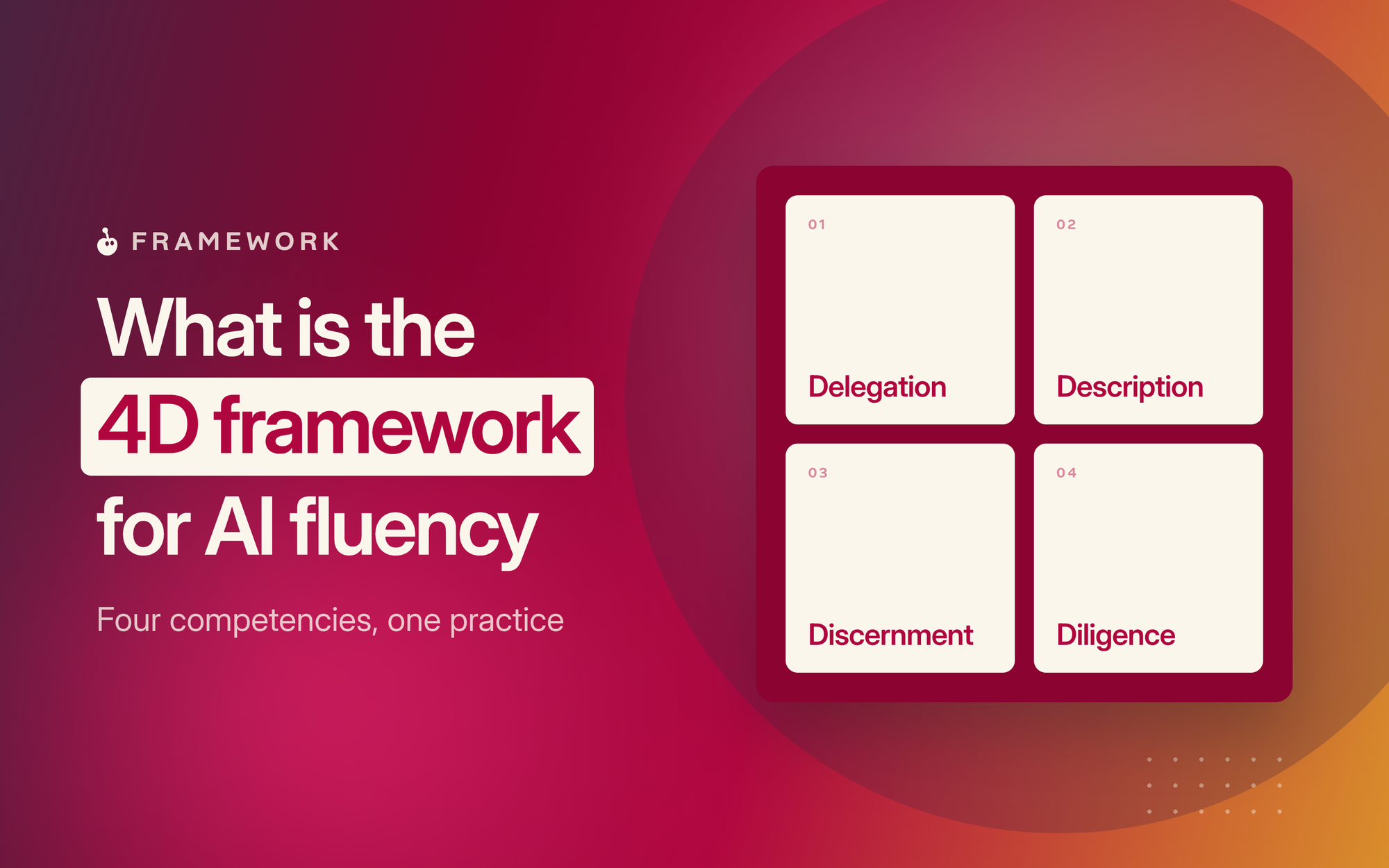
AI Fluency
What is the 4D Framework for AI Fluency
How do you develop AI Fluency and how can this simple 4-part framework developed by Prof Rick Dakan and Prof Joseph Feller help take the first step to developing the practice.

Learning
Map Your Business in 60 Minutes
After this guide, you'll be able to map your entire business into four structured layers that any AI tool can use to give you relevant, context-aware output.

AI Fluency
OpenAI vs. Anthropic: Why This Isn't Really a Competition Anymore
If you're still comparing ChatGPT and Claude like they're competing products, you're missing the bigger picture. These two AI giants are competing in different markets.